
174 people came from our ads. Zero left with the video we sell.
For twelve days, our app looked busy. Then I counted the one result it exists to deliver, and it was zero.
The app is Earshot Teleprompter. You read a script on your iPhone while looking at the lens, and an AI edit turns the raw take into a finished video with cuts and captions. That finished video is what our ads sell and what the paid plan unlocks. From October 12 to October 23, 2026, 174 new people opened the app, mostly from our first paid Meta ads. None of them saved or posted an AI-edited video.
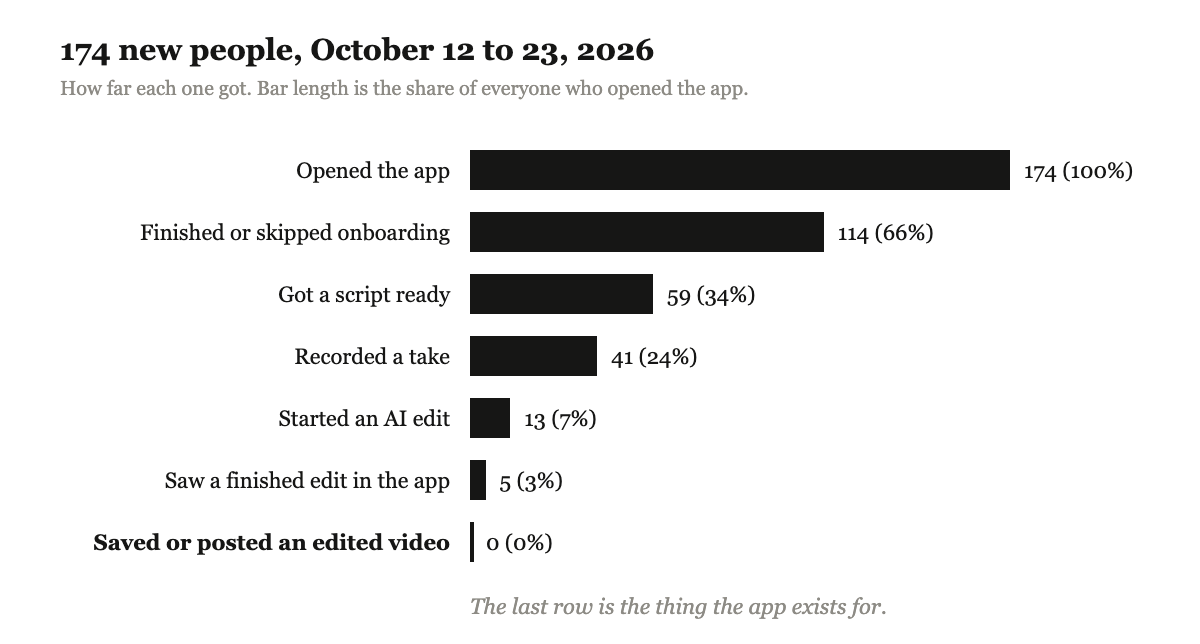
Five bars of motion, then one bar of value, and that last one is empty.
I build this app, so weigh my view with that in mind.
Why does a busy funnel hide an empty result?
Because most funnel steps count effort, not reward. In those two weeks, 114 people got through onboarding, 59 had a script ready and 41 recorded at least one take. That reads like a small product with a leaky top.
But writing a script is work. Recording yourself is work too, and scary work for many people. None of it is the moment someone watches a clean, captioned video of themselves and feels like a pro. That moment is why anyone pays or comes back.
Our cliff sat exactly where the product should shine. Of the 41 people who recorded, only 13 started an AI edit, and only 5 ever saw a finished one in the app. The edit ran on our server for 5 to 12 minutes. Most people were gone within a minute.
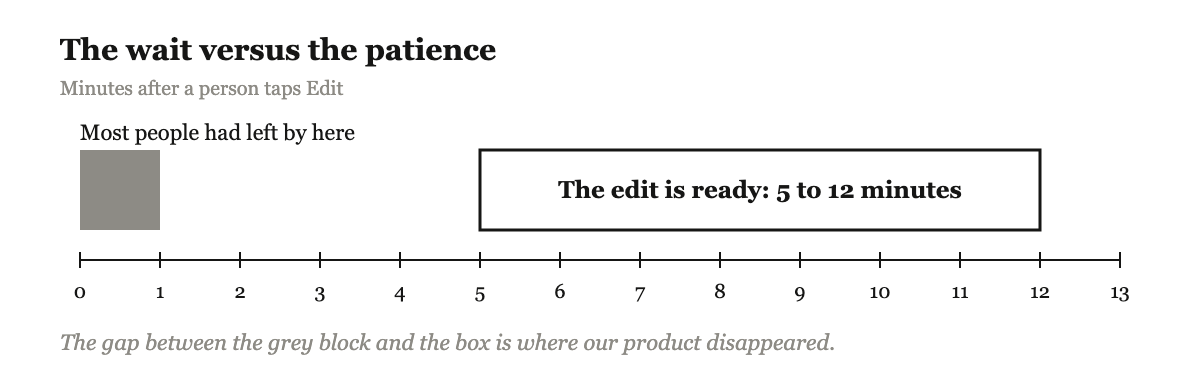
People gave us about a minute. The reward needed five to twelve.
The server logs made it sting more. There, 14 people started an edit, 11 got a finished video, 6 ever opened it, and 0 saved it. Five finished videos sat ready and unwatched. Each person who recorded a take cost us about $9 in ads, and most walked straight into that wait.
Can going deeper into a funnel make people leave?
Yes, when the step where they stop is a dead end. We took the 134 people who arrived from October 12 to 20, sorted them by the furthest step they reached on day one, and checked who came back on a later day. People with a script ready returned 44% of the time. People who recorded a take returned only 15%. The few who saved a raw take returned 0%.
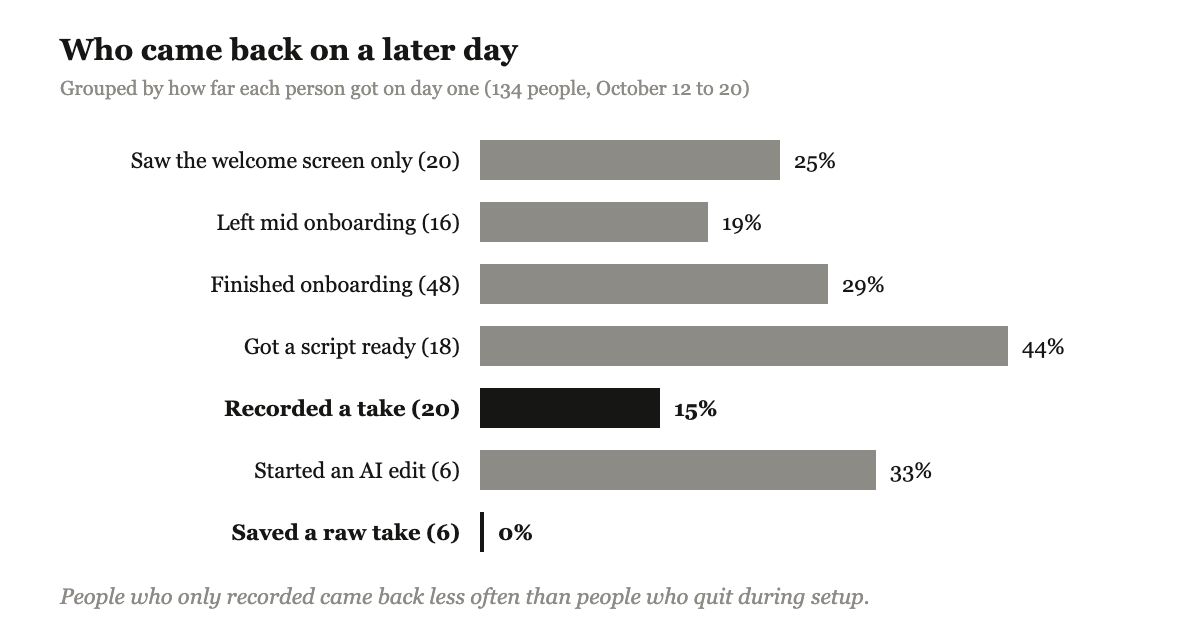
Small groups, so trust the shape: return rises, then falls hard after recording.
Aha: going further into a funnel can make people less likely to return if the step they stop on is a dead end.
Recording without seeing the edit is the worst spot to quit. You did the awkward part and got back a plain phone clip of your own face. A deeper step with no payoff is not progress. It is a sharper letdown.
Growth teams spotted this long ago. Dave McClure's pirate metrics defined activation as users who "enjoy 1st visit: "happy" experience." Facebook's growth team chased 7 friends in 10 days. Slack saw that once a team sent about 2,000 messages, 93% of those teams were still customers.
Aha: McClure's activation, Facebook's 7 friends and Slack's 2,000 messages are the same thing measured in three different products.
Each one counts people who reached the result. Our "recorded a take" counted effort just before the payoff, where a number looks best and means least. Appcues calls the missing piece time to value: "the gap between signup and the moment users experience your product's core benefit."
How do you measure the promised outcome?
Here is the check in five steps.
- Write the promise in one sentence. Use your ad's words. Ours became: the user saves or posts an edited video. Not signed up, not recorded.
- Make that moment a tracked event. For us that meant
edit_savedandedit_posted. - Count people, once each, at their furthest step. Drop test accounts, and join anyone your analytics split in two at sign-in.
- Divide by starters, not by the step before. Ours, against starters: 0 / 174 = 0%.
- Time the gap, then rule out bugs. Compare minutes to value with how long leavers stayed. Then check error logs for the same dates. We found outages and a sideways camera.
Type each step of your funnel and how many people reached it into the tool below, then mark which step is your moment of value.
If it warns that fewer than 10% of starters reach that step, hold off on buying traffic.
Who else falls into this trap?
Any product whose reward arrives after effort or a wait. Take a solo founder with an AI headshot app. Uploads look great, but the value is downloading a headshot someone actually uses. If training takes twenty minutes, most people never see one. The fix is a rough preview in the first minute, then counting downloads, not uploads.
What we are changing
Every person who records should see a finished edit. The edit will start on its own after the first take, the result will appear inside the app, and we will ask to send a notification right when people are waiting. The paywall moves to after the first finished video, so people pay for something they have seen.
A bad attempt is not a bad idea. What broke was the road from tap to reward. Next time we run the numbers, I will count the last row first.
Read the full article on Medium
Sources
- Startup Metrics for Pirates: AARRR! (Startonomics SF 2008), Dave McClure, SlideShare
- Facebook Growth Focus, Chamath Archive
- Chamath on Growing Facebook, Matt Mullenweg, March 20, 2016
- The Cold Start Problem, Andrew Chen, Penguin Books Australia listing
- Reader highlights from The Cold Start Problem on Slack's 2,000 messages, Goodreads
- How to shorten time to value with better user onboarding, Katryna Balboni, Appcues, May 27, 2026